AI is dogshit at design
Apr 2026
As a matter of professional good practice, I’ve used most of the AI design tools that exist right now, enough to have a reasonably informed opinion. I feel comfortable saying, here in roughly the first quarter of 2026: AI is still genuinely bad at design. Not “needs some polish” bad. Not “promising but early” bad. Just kind of shit at it.
The output is always wrong in the same way: uncanny valley design. The pieces are there: there’s some kind of hierarchy, there’s sort of correct copy, there’s a kind of a visual rhythm. It looks, at a glance, like design. But there’s no there there. No intent. No sense that any individual decision was made in service of communicating something to someone.
This isn’t a knock on the tools so much as just a consequence of how they work: it’s a regurgitation machine. LLM output is produced by asking (hand-waving wildly here) “given what came before, what comes next?” That’s a genuinely cool thing to be able to do! It’s buckwild that it works at all! But: it means the model has no access to the reasoning of any of it, only to the artifacts. AI is trapped within a inescapable vortex of which of the two possible websites are you currently designing? – It can learn the patterns but not the why. The why is invisible, and unfortunately (for AI), the why is the work.
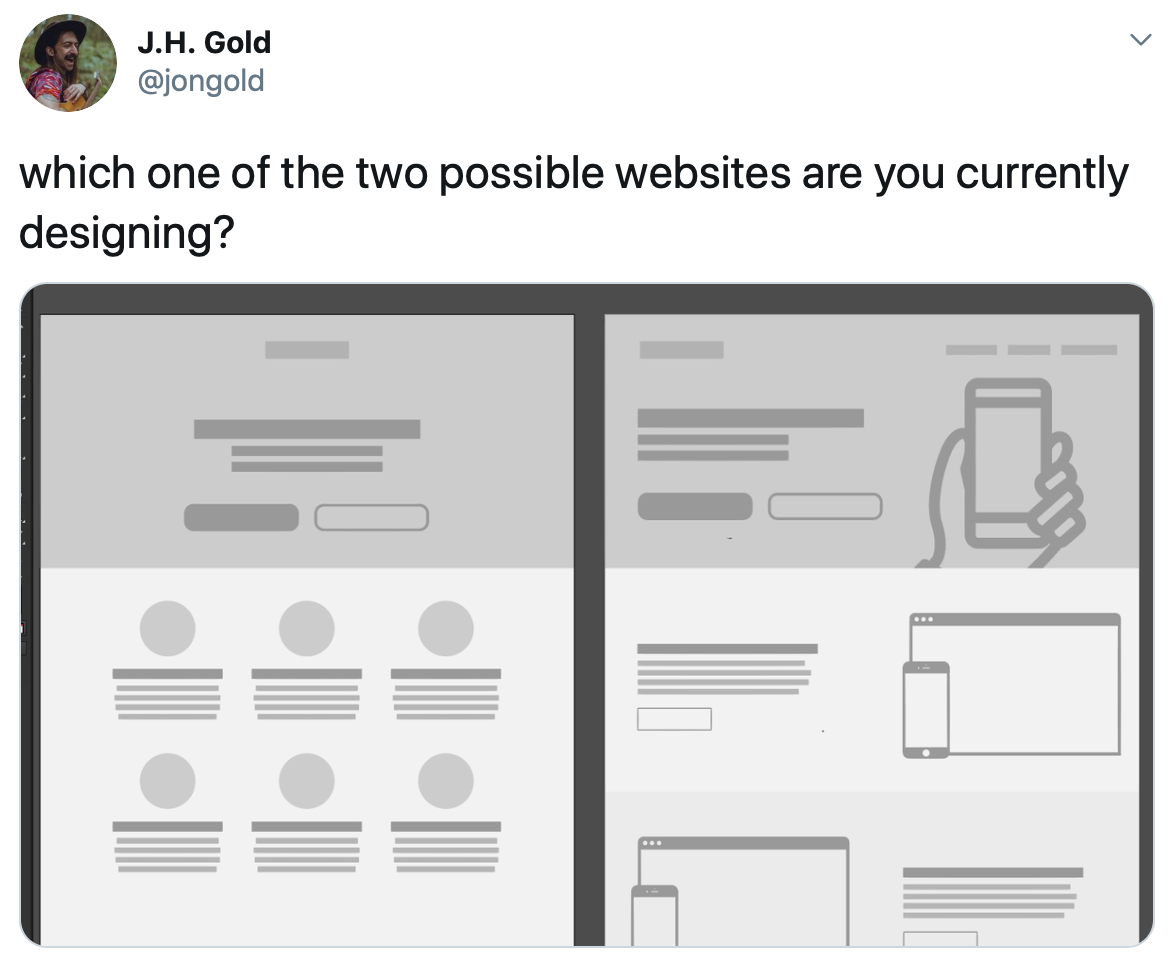
Is AI totally useless in a design context? No, and it’d be dishonest for me to claim otherwise. “Give me N first approximations of solutions to this problem” is a decent use of these tools. So is “build me a playground for this concept so I can explore the space interactively.” Neat! That’s valuable! But there’s a Grand-Canyon-sized chasm between something to react to and something to ship. The human is still wedged in the loop, and not in a ceremonial way – in a “this doesn’t work without me” way.
Here’s the thing that muddies this whole screed: whether we (designers) like it or not, the job has changed. Not just my job – the job. The way design gets delivered looks different than it did a year ago. I’m pushing code nearly every day, doing things I’d have previously handed off. If you’re a designer who isn’t riding this trend, who doesn’t understand what’s actually possible with these tools (even if you don’t use them), you’re going to have an increasingly difficult time understanding where your role still has value (as perceived by others, if nothing else).
And it does have value! Pretty much in the same place it always did: critical judgment. Staring at something and knowing it’s wrong before you can concretely explain why. That hasn’t shifted. It’s just that getting to that moment now looks different. The path changed, but the destination is the same as it’s always been.
So what? AI is handling the stuff that’s cheap to get wrong and well-defined enough to automate. Design – real design, the stuff that makes a product feel like someone cared – is still a human job. I don’t think that’s wishful thinking. I think it’s just what’s true for the foreseeable future.